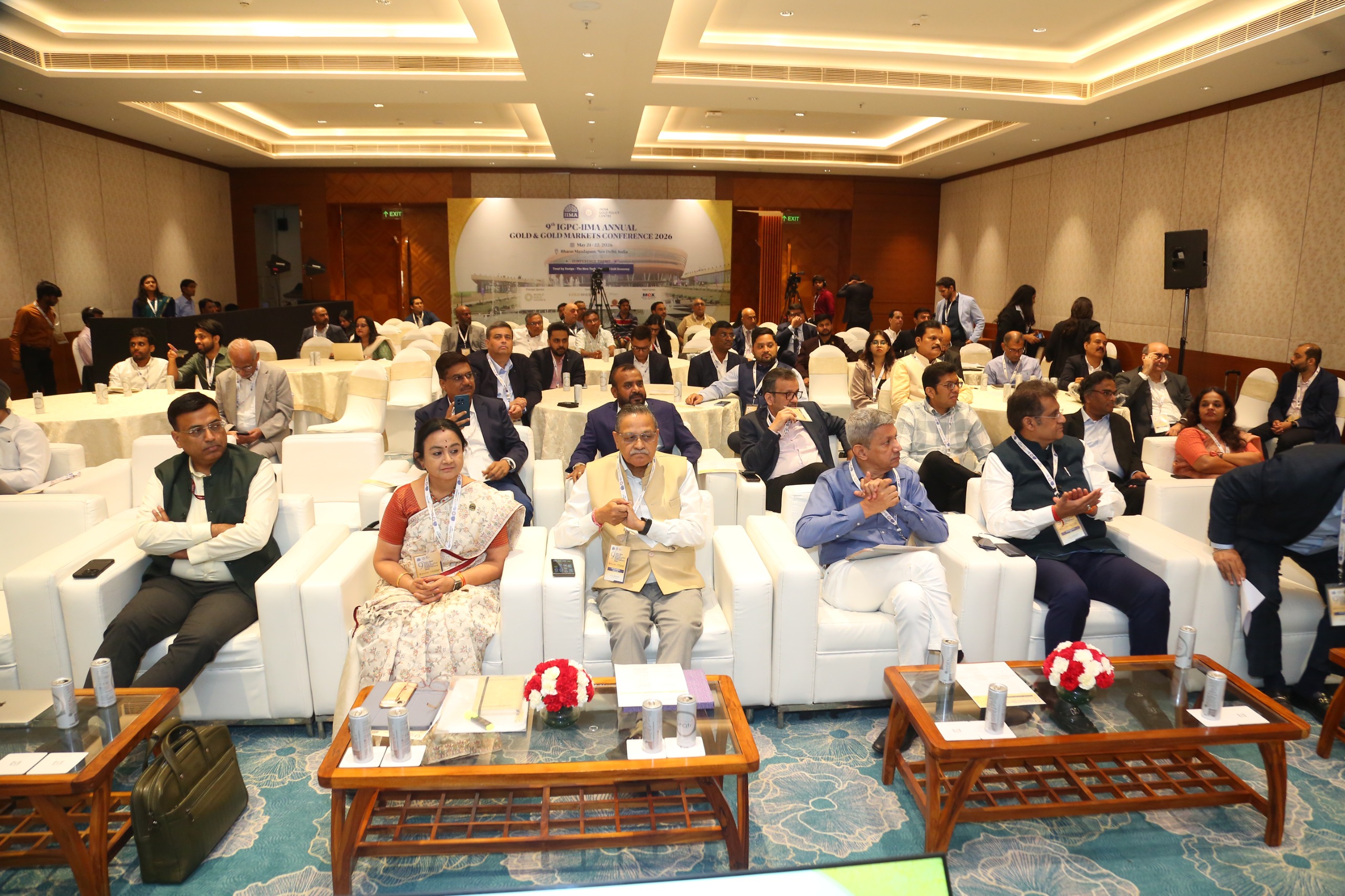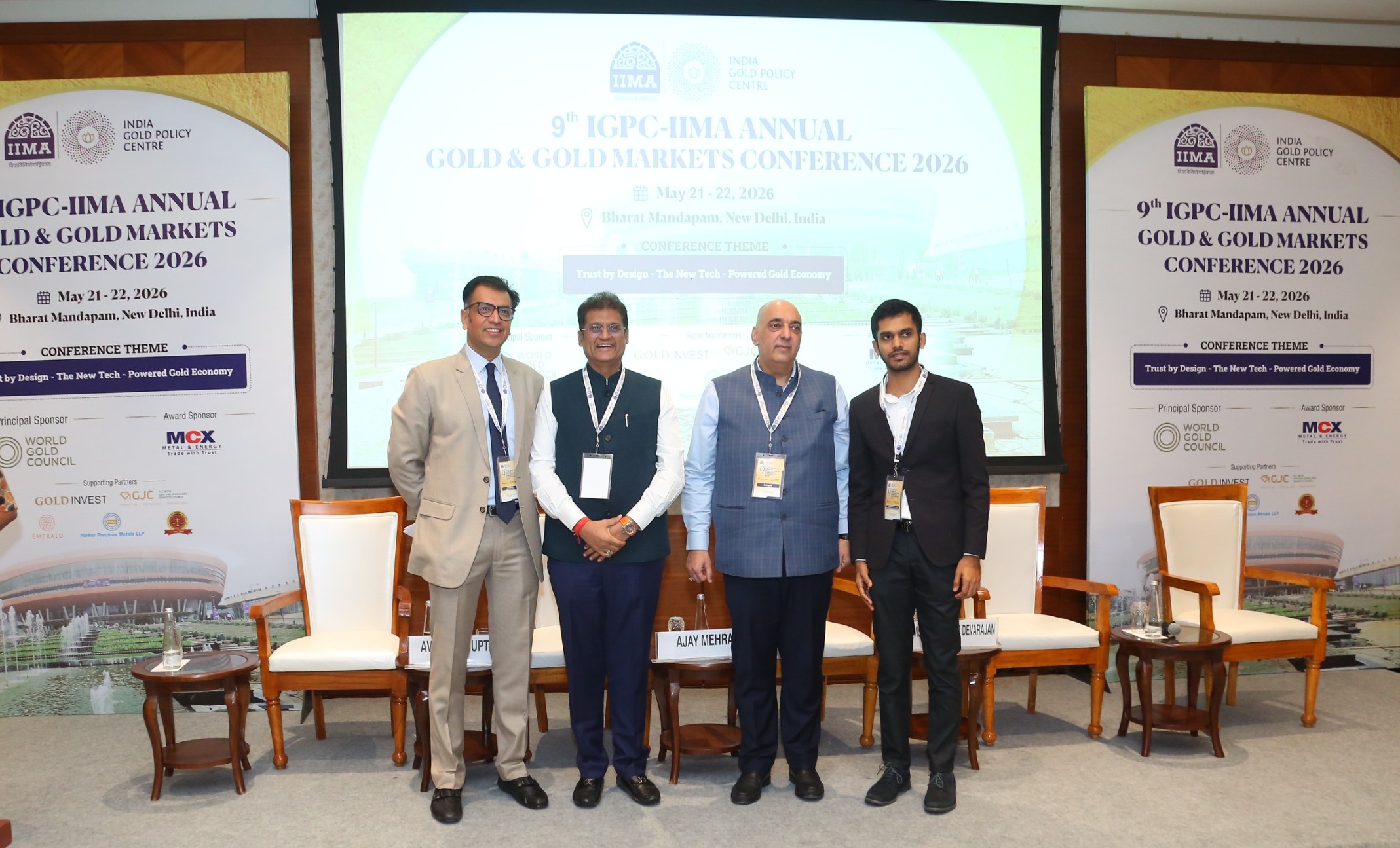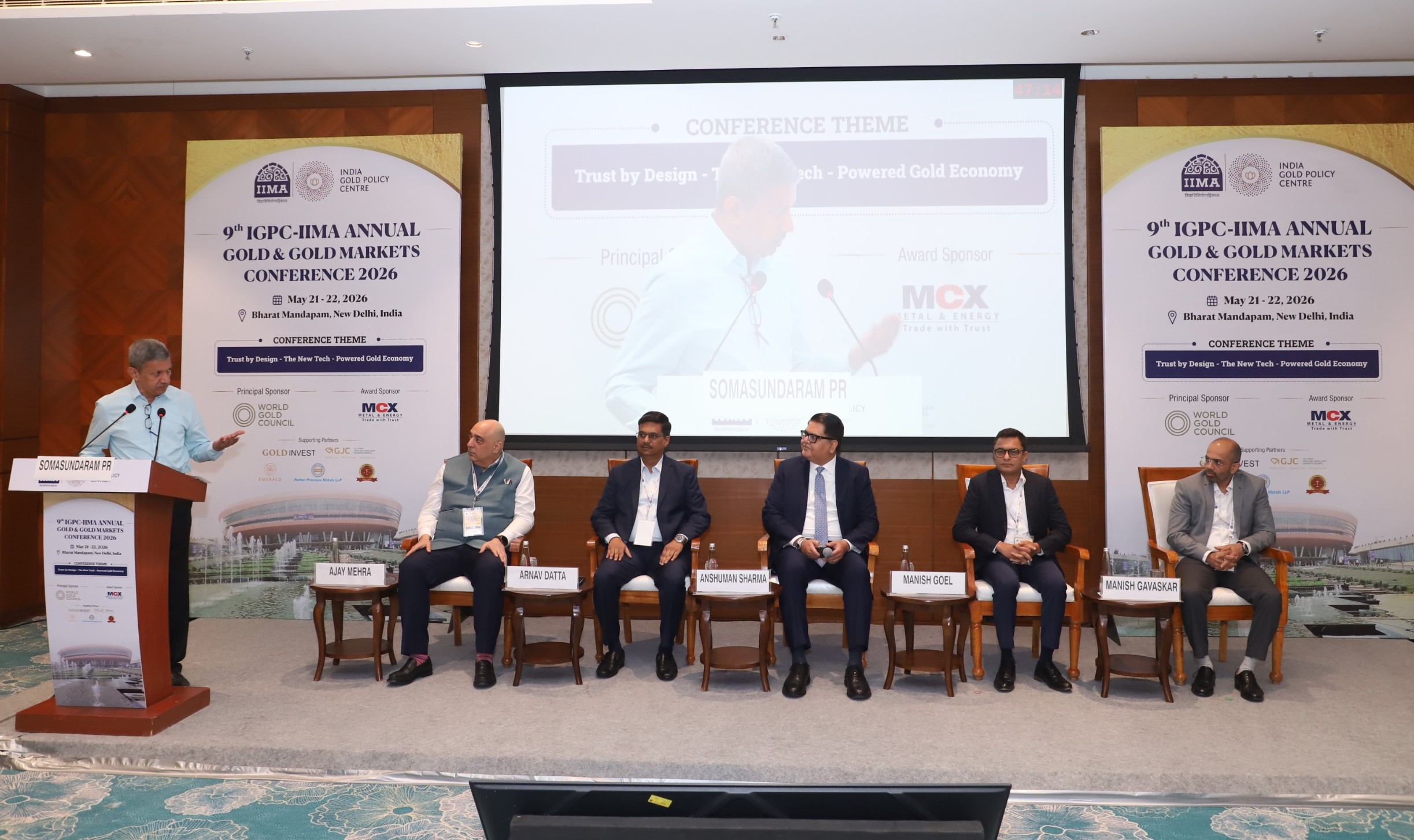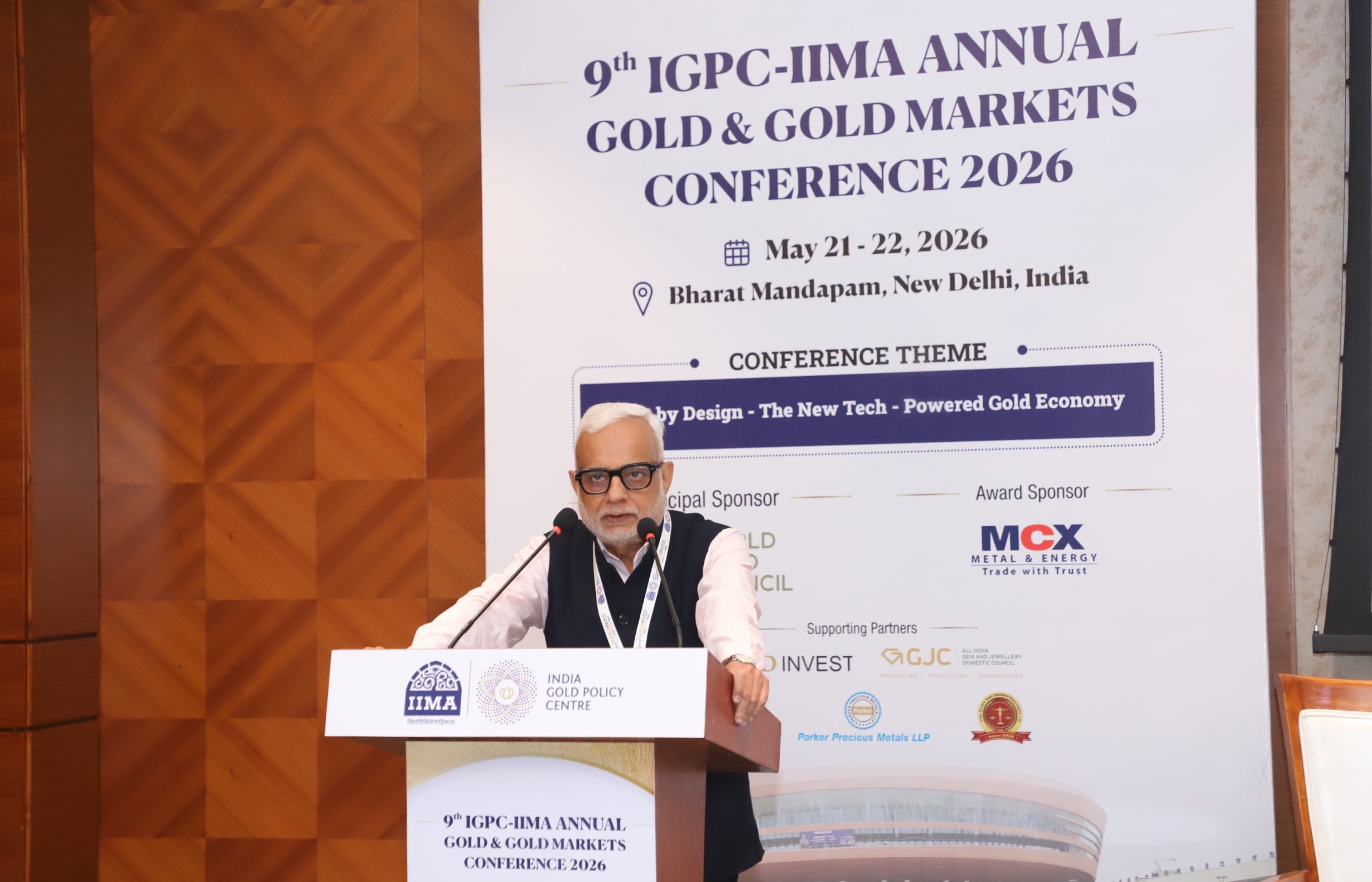

~ The conference deliberated on various factors impacting the gold economy, including technology-driven innovation and governance, strengthening India’s gold markets, and identifying gaps to address in the market, among others.
~ The conference brought together various stakeholders from academia, industry, and policymaking for deliberation and meaningful insights on the gold economy.
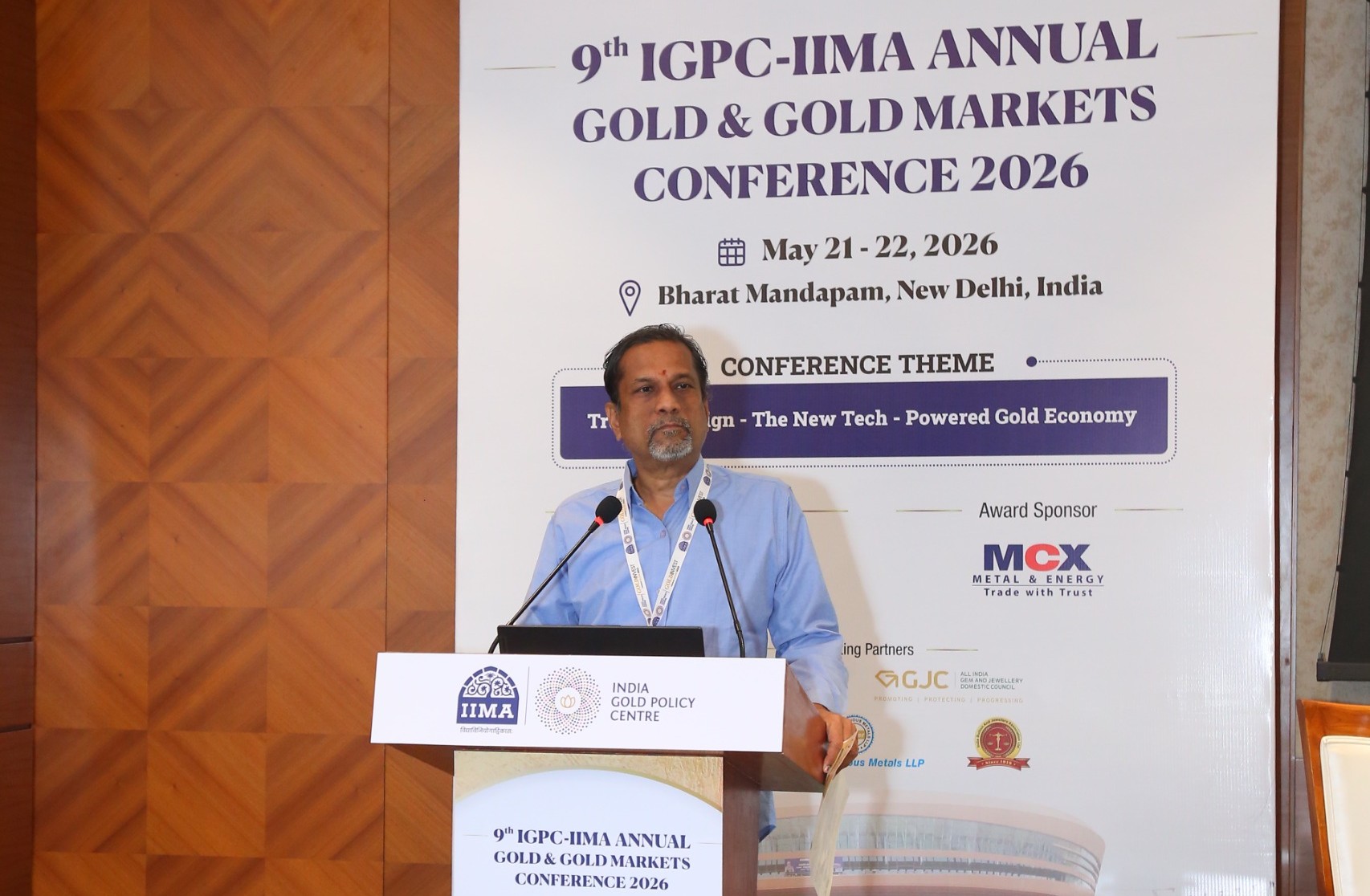
May 23, 2026: The India Gold Policy Centre (IGPC) at the Indian Institute of Management Ahmedabad (IIMA) organised the 9 th edition of IGPC-IIMA Annual Gold and Gold Markets Conference 2026 on May 21-22, 2026, at Bharat Mandapam in New Delhi.
The conference was inaugurated by Professor Bharat Bhasker, Director, IIMA; Professor Sundaravalli Narayanaswami, Chairperson, IGPC; Mr. Amit Singla, Department of Economic Affairs, Ministry of Finance, and Mr. Sachin Jain, India CEO, World Gold Council. Dr. Sridhar Vembu, Chief Scientist, Zoho Corporation, and Dr. Hasmukh Adhia, IAS (Retd.) and Principal Advisor to the Chief Minister of Gujarat, graced the conference as Chief Guests.
Building on the pivotal role of technology across various domains, this year’s theme, ‘Trust by Design – The New Tech-Powered Gold Economy’ – deliberated on the evolving nature of global and Indian gold markets, the importance of technology-led governance in the sector, gaps that limit the gold market from achieving its full potential, and India’s evolving gold trade policy.
In his keynote address, Dr. Hasmukh Adhia, IAS (Retd.) and Principal Advisor to the Chief Minister of Gujarat, reflected his deep administrative experience in the Union Ministry of Finance, as he highlighted several crucial points, including the importance of managing gold imports, the necessity of gold financialisation, developing India’s ability to set gold pricings, and managing the lasting impacts of reactionary policymaking.
Dr. Sridhar Vembu, Chief Scientist, Zoho Corporation, delivered an insightful keynote address underlining the significance of building world-class technology in India, particularly for the gold markets. He emphasised on the necessity of transforming gold flow as capital to derive value and economic growth from it. Underscoring his talk was the importance of strengthening trust in the sector, which cannot solely be created through regulation. Dr. Vembu added that trust must be embedded across systems and institutions for gold to contribute to the Indian economy.
In his welcome address, Professor Bharat Bhasker acknowledged the diversity of stakeholders at the conference, remarking on the value of gaining diverse perspectives from participants, which would translate into future-facing policy dialogue. He reflected on the importance of gold in India’s economy, correlating it to the present-day scenario. He noted that the conference provides a platform to several stakeholders to deliberate how gold can best contribute to the Indian economy, particularly amidst global uncertainties.
Explaining how India’s gold industry stands at a crucial junction of structural transformation, Professor Sundaravalli Narayanaswami, Chairperson, IGPC, emphasised the conference’s significance in fostering collaboration and innovation within the sector. She also spoke of global uncertainty, shifting supply chains, and financialisation, that would catalyse significant change for the India’s gold markets.
Prof. Narayanaswami also gave a presentation covering the current obstacles plaguing the Indian bullion industry, how bullion imports should be consolidated through a unified single channel, and leasing of gold mines in countries that are favourable through a hybrid annuity model (HAM) Public Private partnerships. She also proposed bringing household gold into the formal economy by setting up a Gold Trust of India, like any other public interest trusts, in which citizens can register their bullion donations through an authorised system to get tax benefits similar to section 80G donations to trusts. All such collected bullion can be recirculated in the market or be deposited into the central bank as bullion reserves. She also recommended a separate ministry for bullion and precious metals or a dedicated entity such as Swarn Shakti for unified business transactions and policy decisions. The objective should be towards making India the Gold capital of the World and making it a two-way price setter country.
The conference also featured some thought-provoking keynote sessions by industry experts. In his keynote speech, Mr. Sachin Jain of World Gold Council, spoke of India’s unique and evolving position in the global gold market, highlighting how the coming years can witness the precious metal being derived from Indian mines. Mr. Mohit Makhija of Crisil Ratings Ltd., focused on developing trust across various stakeholders of the industry, including customers, regulators, and investors. Offering an insightful perspective of India’s commodity markets, Ms. Parveena Rai, MCX, underlined the role of exchanges in creating trusted market infrastructure through robust trading systems, efficient settlements, technology-led governance.
Along with the insightful keynote speeches and addresses, the conference also featured six multifaceted and engaging panel discussions on ‘Gold Demand: From Value to Identity – Has it Matured?’; ‘Inhibitions, Tentativeness and Complexity’; ‘Future Lens on Gold Markets: Identifying Today’s Missing Pillars’; ‘Rewriting Gold Trade Policy: Building India’s Global Gold Hub’; ‘Rewiring Gold Markets: The Digital and Tokenised Future’, and ‘Players, Policy and Priorities – Can Self-Regulations Work in India’s Gold Market?’. These sessions brought together leading industry experts, jewellers, refiners, senior representatives from banks, exchanges, and policy research institutions.
Both days of the conference witnessed academic and industry paper presentations by authors from various Indian institutions, adding valuable depth to the conference proceedings, and demonstrating the need for collaborative change towards tech-based solutions to achieve the full potential of the gold economy. The papers examined myriad factors that are shaping the global and Indian gold economy, including changing customer preferences, supply-chain disruptions, cross-border trade practices, investment demand, and geopolitical uncertainty. Overall, the deliberations throughout the conference demonstrated the need for a collaborative change towards tech-based solutions so that the economic potential of gold can be fully realised.
About IIM Ahmedabad:
The Indian Institute of Management Ahmedabad (IIMA) is a premier global management Institute that is at the forefront of promoting excellence in the field of management education. In more than six decades of its existence, the Institute has been acknowledged for its exemplary contributions to scholarship, practice, and policy through its distinctive teaching, high-quality research, nurturing future leaders, supporting industry, government, social enterprise, and creating a progressive impact on society.
IIMA was founded as an innovative initiative by the Government, industry, and international academia in 1961. Since then, it has been consolidating its global footprint, and today it has a network with over 80 top international institutions and a campus in Dubai. Its eminent faculty members and more than 47,000 alumni, who are at the helm of influential positions in all walks of life, also contribute to its global recognition. Over the years, IIMA’s academically superior, market-driven, and socially impactful programmes have earned a high reputation and acclaim globally. It became the first Indian institution to receive international accreditation from EQUIS. The Institute is also placed first in the Government of India’s National Institutional Ranking Framework (NIRF), India Rankings 2025. The Institute has been ranked 35th globally in the Financial Times (FT) Executive Education Rankings (Open) 2025. The renowned flagship two-year Post Graduate Programme in Management (PGP) is ranked 34th in the FT Masters in Management Ranking 2025, and the Full-Time One-Year Post Graduate Programme in Management (MBA-PGPX) has been ranked 27th in the FT Global MBA rankings 2026.
IIMA offers consultancy services and more than 200 curated executive education programmes in customised, blended, and open enrolment formats for a diverse audience comprising business leaders, policymakers, industry professionals, academicians, government officials, armed forces personnel, agri-business, and other niche sector specialists and entrepreneurs.
To know more about the Institute, please visit: https://www.iima.ac.in/
For media queries, please contact:
Ms. Shivangi Bhatt | manager-comm@iima.ac.in
Ms. Krishna Barot| pr@iima.ac.in