
20/07/2026


Abstract:
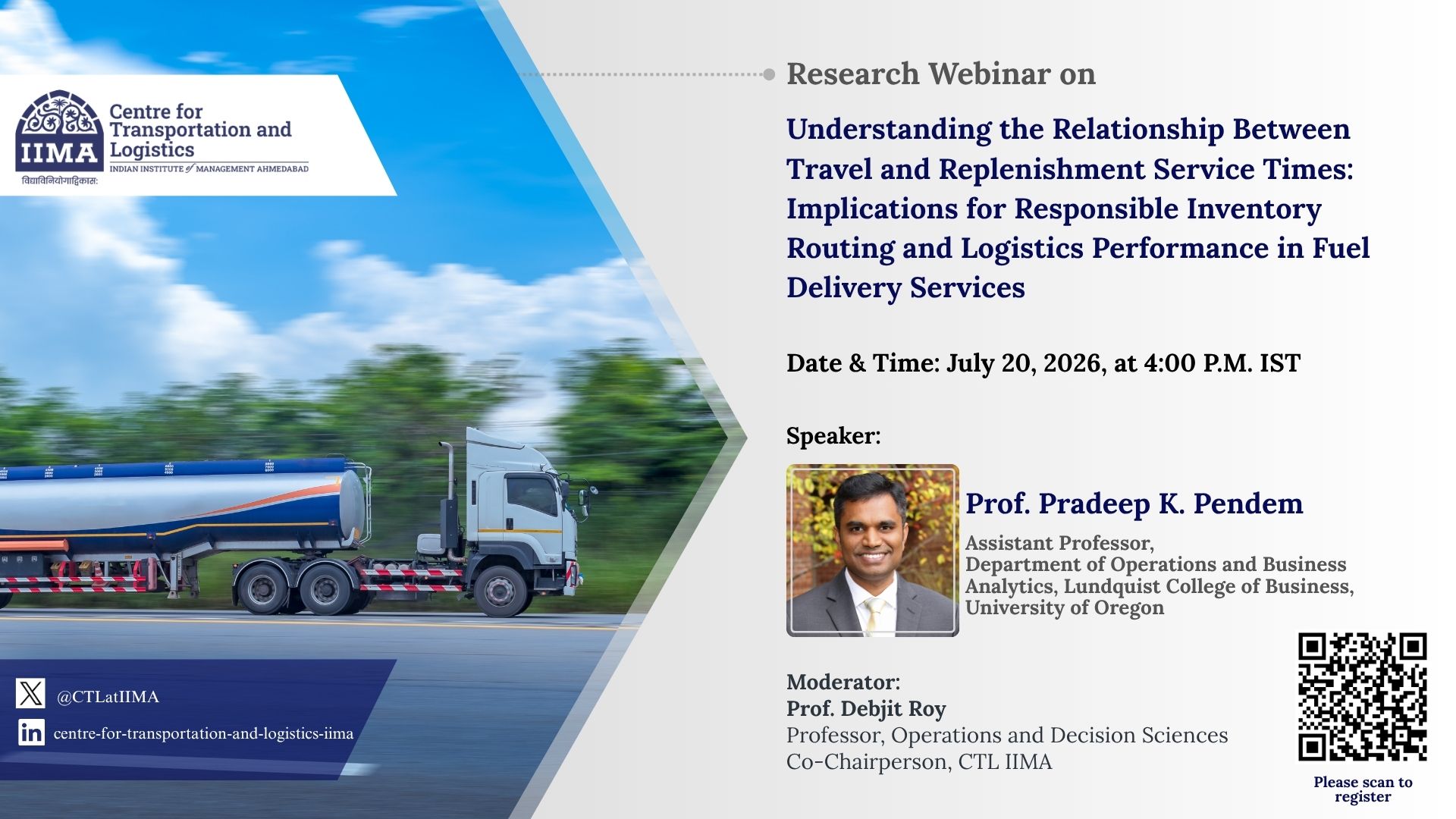
We investigate the causal relationship between replenishment service and travel times, arising from the underlying driver-centric fatigue behavior that manifests in an inventory-routing context, which is not considered in the literature. Data from a North American propane delivery company are used, employing recursive, simultaneous- equation system models to assess the relationship.
The findings indicate that service time increases with cumulative travel time or travel time per mile, whereas travel time per mile decreases with service time. These results provide evidence of the mechanism by which driver fatigue, arising from prolonged driving and manifesting as slower driving, adversely affects the time to perform the fatigue-inducing activities on-site.
Interestingly, drivers' idle time during automated fuel replenishment, affected by replenishment policy, serves as a rest period, mitigating/relieving fatigue associated with driving and consequently reducing travel time per mile. The estimates indicate that a one- minute increase in service time reduces travel time per mile by 3.0-3.7%, both within and across driver shifts.
Our study suggests that inventory-routing firms endogenously incorporate the relationship between replenishment and travel times in such environments when determining optimal driver-scheduling and replenishment policies. A holistic optimization can help develop responsible schedules to improve drivers' well-being and retention in the long run.
About the Speaker:
Prof. Pradeep K. Pendem is an Assistant Professor in the Department of Operations and Business Analytics at the Lundquist College of Business, University of Oregon. His research examines the causal impact of operational decisions on organizational and individual performance, with a particular focus on uncertainty arising from customer, employee, and service provider behaviors. His work combines large-scale real-world data from industries such as retail, healthcare, agribusiness, and transportation with advanced methods from econometrics, statistics, and optimization to generate rigorous and managerially relevant insights.
Pendem's research has been published in leading operations management journals, including Management Science, Manufacturing & Service Operations Management (M&SOM), and the Journal of Operations Management (JOM). His work has had significant policy impact, with findings cited in the preamble to the U.S. Congress bill - Schedules That Work Act (H.R. 6670), and in the 2022 U.S. Economic Report of the President. His research has also been featured in prominent media outlets, including The Wall Street Journal, The New York Times, The Economist, Human Resources Director, and The Huffington Post. His research has received several prestigious honors, including the 2022 M&SOM Responsible Research Award, the 2019 Decision Sciences Institute Elwood S. Buffa Doctoral Dissertation Award, finalist recognition in the 2019 M&SOM Data-Driven Research Challenge, and the 2021 Goulet Outstanding Junior Faculty Research Award at the University of Oregon.
Dr. Pendem earned his Ph.D. in Operations Management from the Kenan-Flagler Business School at the University of North Carolina at Chapel Hill. His teaching interests include Data-Driven Predictive Modeling and Operations Management. He is a member of the Decision Sciences Institute (DSI), the Production and Operations Management Society (POMS), and the Institute for Operations Research and the Management Sciences (INFORMS). Prior to joining academia, he worked as an Operations and Forecasting Analyst at Fidelity Investments.