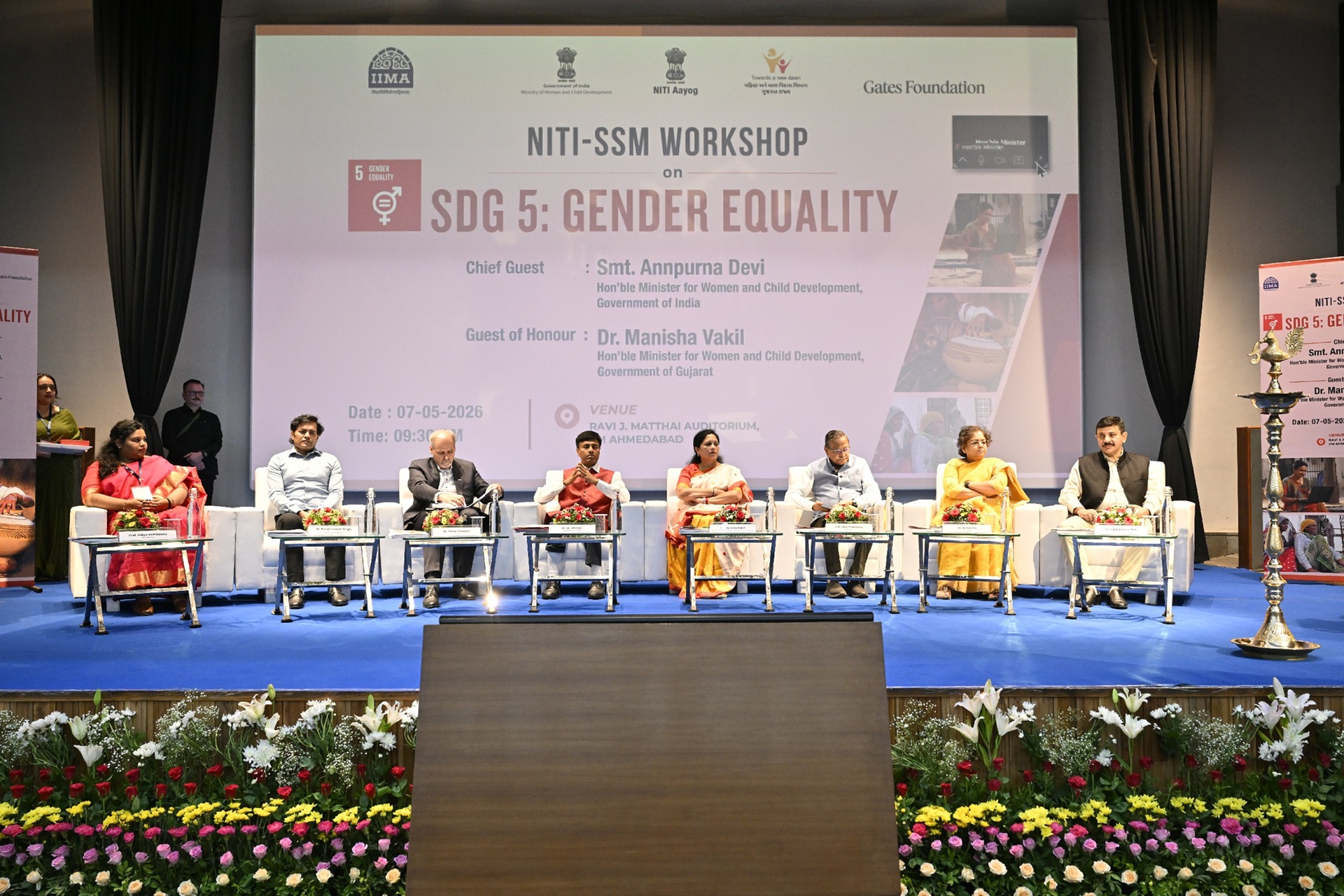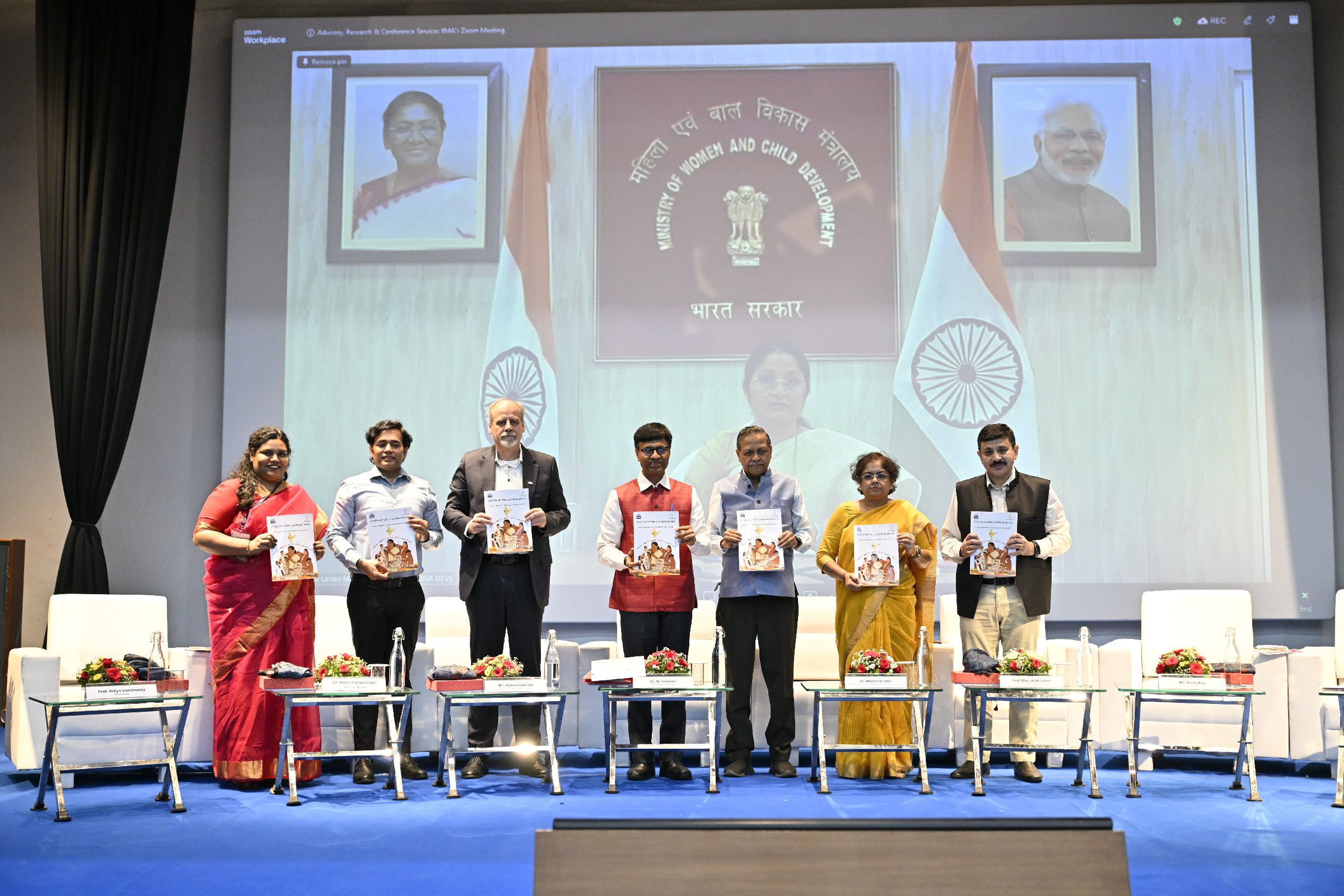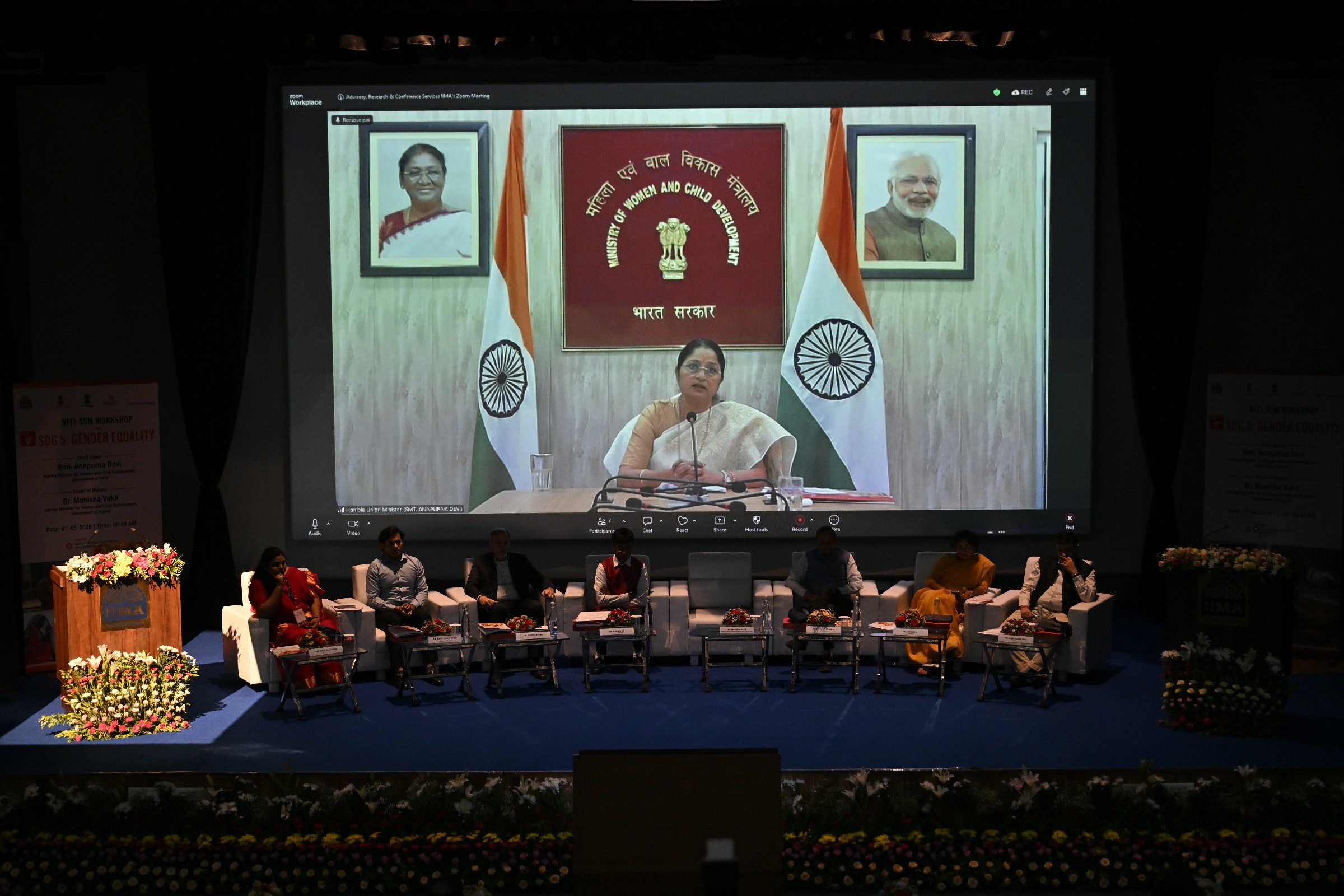

~ Smt. Annpurna Devi, Hon’ble Minister of Women and Child Development, Government of India, graced the occasion virtually and launched the SDG 5 State, Union Territories, and District Reports. She emphasised the importance of quality data, robust ecosystems, tech-enabled monitoring systems, and time-bound evaluations for dynamic policymaking
~ The inaugural session was also graced by Dr. Manisha Vakil, Hon’ble Minister for Women and Child Development, Government of Gujarat; and Dr. M. Srinivas, Member, NITI Aayog; Mr. Stefan Priesner, United Nations Resident Coordinator (UNRC), India, and Prof. Bharat Bhasker, Director, IIMA, among others.
~ The SDG 5 State, Union Territories, and District Reports offer data-driven insights on 26 key gender equality indicators across 792 districts in India.
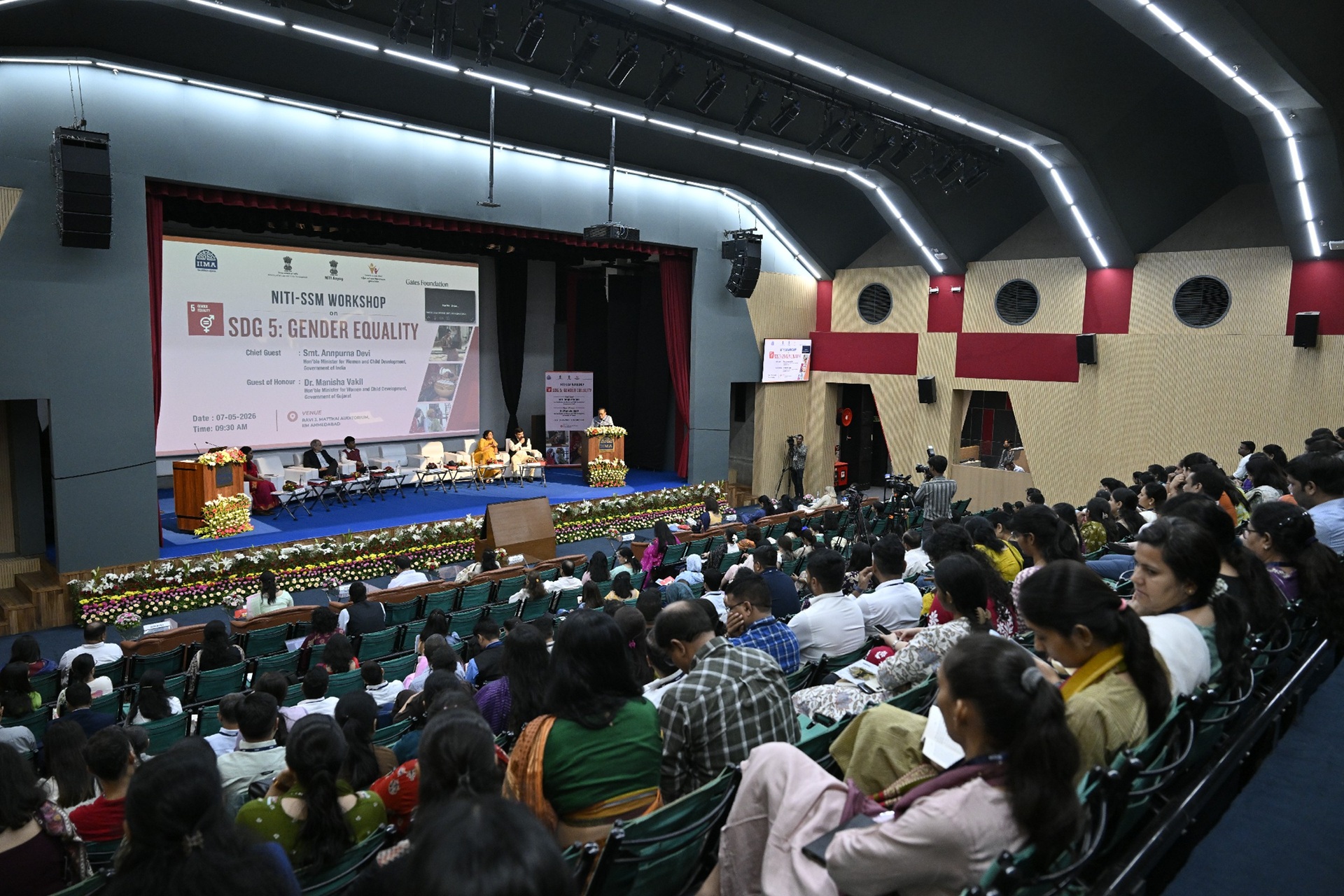
~ The Workshop also hosted three insightful panel discussions, covering myriad aspects of SDG 5 goals to foster collective, data-driven action for women-led development.
May 8, 2026: The Indian Institute of Management Ahmedabad (IIMA), in collaboration with NITI Aayog, Gates Foundation, and the Government of Gujarat, hosted an insightful NITI- SSM Workshop on Sustainable Development Goal (SDG) 5: Gender Equality at the IIMA campus on May 7, 2026. The purpose of the workshop was to launch the State, Union Territories, and District Reports on SDG 5 and disseminate their findings to accelerate women-led development.
The inaugural session was graced by Smt. Annpurna Devi, Hon’ble Union Minister of Women and Child Development, Government of India, virtually, along with the presence of Dr. Manisha Vakil, Hon’ble Minister for Women and Child Development, Government of Gujarat; Dr. M. Srinivas, Member, NITI Aayog; Mr. Stefan Priesner, United Nations Resident Coordinator (UNRC), India; Mr. Rajib Kumar Sen, Programme Director, Women and Child Development Division; Professor Bharat Bhasker, Director, IIMA, and Professor Vidya Vemireddy, Faculty Member, IIMA.
The event also brought together senior government officials from Indian States and Union Territories, representatives from various Ministries of the Government of India, policy makers, and international agencies such as the UN, UNDP, UNICEF, UNWOMEN, and World Bank, along with NGOs and sectoral experts working in the field to share insights for evidence-based action at the district level.
The SDG 5 State, Union Territories, and District Reports were launched by Smt. Annpurna Devi during the workshop. The reports offer granular, data-driven insights on 26 key gender equality indicators across 792 districts in India. These insights will serve as a tool for various stakeholders to identify regional disparities, monitor growth progress, prioritise interventions, and ensure targeted resource allocation, among other endeavours.
In her keynote address during the inaugural session, Smt. Annpurna Devi highlighted the importance of good data, robust ecosystems with tech-enabled monitoring, time- bound evaluations for dynamic policy making, and local-level feedback mechanisms, especially in schemes for women and children. She said that in today's digital era, data has become the cornerstone of policymaking. Technology, artificial intelligence, and real-time data systems have made more precise and effective interventions possible. She said that under the leadership of Prime Minister Narendra Modi, the country is moving rapidly on the path of “Women-led Development”. She highlighted various initiatives by the Government of India for women’s betterment and empowerment, and progress made in them over the last few years.
Furthermore, Smt. Annpurna Devi applauded the initiative as important and commendable towards realising the vision of people-centric development through data policy convergence and local action. She added that the discussions to be held in the workshop will prove to be important in realising the collective resolve of Viksit Bharat 2047. The pace of change and its impact become more widespread when the government, society, and various development institutions work together.
Dr. Manisha Vakil emphasised the importance of the report in fostering data-driven governance to achieve the Viksit Bharat 2027 vision, saying, “The vision of Hon’ble Prime Minister Shri Narendra Modi for Viksit Bharat 2047 recognises women-led development as the foundation of India’s progress and a key driver to achieve SDG 5: Gender Equality. I appreciate the Indian Institute of Management Ahmedabad for this important district-level evidence-based analysis, aligned with NITI Aayog’s focus on data-driven governance. Such granular insights will help translate policy into stronger outcomes for women — from local implementation to national impact — through better planning, execution, and accountability.”
Professor Bharat Bhasker, Director, IIMA, lauded the report launch as one of IIMA’s diversified approaches towards management education and women empowerment, saying, “Since inception, IIMA has not only pioneered growth for the corporate and economic sectors, but also fostered holistic growth that would lead to the overall development of the nation. The SDG 5 goals are of paramount importance, as women need to be counted as an equal partner in our country’s growth journey. At IIMA, we contribute towards the upliftment of women through diverse programmes and pathways. We firmly believe that women empowerment doesn’t happen by climbing a ladder; it happens by being the owner of the ladder.” Prof. Bhasker also highlighted various programmes of IIMA for women entrepreneurs.
Dr. M. Srinivas, Member, NITI Aayog, emphasised looking at the success stories and taking Sankalp to take it everywhere. Mr. Stefan Priesner, United Nations Resident Coordinator (UNRC), India, accentuated that locally driven SDG progress reaching women and girls in every district and panchayat will directly contribute to the vision of Viksit Bharat 2047.
Mr. Rajib Kumar Sen spoke about the importance of SDG for inclusive sustainable development and addressing gaps in women empowerment policies with data-led solutions. Professor Vidya Vemireddy, faculty member of IIMA, who served as the Principal Investigator and Lead Author of the reports, presented key findings of the report and explained its purpose to the participants.
The SDG 5 Workshop also organised three insightful panel discussions exploring different aspects of achieving gender equality. Session 1 on ‘From Data to Decisions: Strengthening SDG 5 Monitoring and Evidence’ highlighted the importance of strengthening data ecosystems and evidence-based policymaking for advancing SDG 5. Session 2 on ‘Economic Empowerment of Women: Work, Wages, and Wealth’ focused on women’s economic empowerment, particularly the challenge of translating participation into sustainable incomes, asset ownership, and economic agency. Session 3 on ‘Social Empowerment of Women’ highlighted community-led approaches, behavioural interventions, and integrated service delivery models for advancing gender equality.
Overall, the workshop reinforced the importance of moving from broad policy approaches to more granular, district-focused strategies for advancing gender equality. The discussions demonstrated how the SDG 5 State, UTs, and District analysis can serve as a critical tool for supporting data and evidence-led decision-making, enabling them to better understand local challenges and design context-specific interventions. The workshop marks an important stepping stone towards deeper engagement with states, UTs, and districts through continued handholding and policy support. Going forward, the insights generated through this initiative will support in identifying priority areas, strengthening convergence across schemes, improving monitoring systems, aligning budgets with local needs, and translating evidence into actionable strategies on the ground to accelerate progress towards SDG 5.
About IIM Ahmedabad:
The Indian Institute of Management Ahmedabad (IIMA) is a premier global management Institute that is at the forefront of promoting excellence in the field of management education. In more than six decades of its existence, the Institute has been acknowledged for its exemplary contributions to scholarship, practice, and policy through its distinctive teaching, high-quality research, nurturing future leaders, supporting industry, government, social enterprise, and creating a progressive impact on society. IIMA was founded as an innovative initiative by the Government, industry, and international academia in 1961. Since then, it has been consolidating its global footprint, and today it has a network with over 80 top international institutions and a campus in Dubai. Its eminent faculty members and more than 47,000 alumni, who are at the helm of influential positions in all walks of life, also contribute to its global recognition. Over the years, IIMA’s academically superior, market-driven, and socially impactful programmes have earned a high reputation and acclaim globally. It became the first Indian institution to receive international accreditation from EQUIS. The Institute is also placed first in the Government of India’s National Institutional Ranking Framework (NIRF), India Rankings 2025. The Institute has been ranked 35th globally in the Financial Times (FT) Executive Education Rankings (Open) 2025. The renowned flagship two-year Post Graduate Programme in Management (PGP) is ranked 34th in the FT Masters in Management Ranking 2025, and the Full-Time One-Year Post Graduate Programme in Management (MBA-PGPX) has been ranked 27th in the FT Global MBA rankings 2026.
IIMA offers consultancy services and more than 200 curated executive education programmes in customised, blended, and open enrolment formats for a diverse audience comprising business leaders, policymakers, industry professionals, academicians, government officials, armed forces personnel, agri-business, and other niche sector specialists and entrepreneurs.
To know more about the Institute, please visit: https://www.iima.ac.in/
For media queries, please contact:
Ms. Shivangi Bhatt | manager-comm@iima.ac.in
Ms. Krishna Barot| pr@iima.ac.in