

14/08/2026


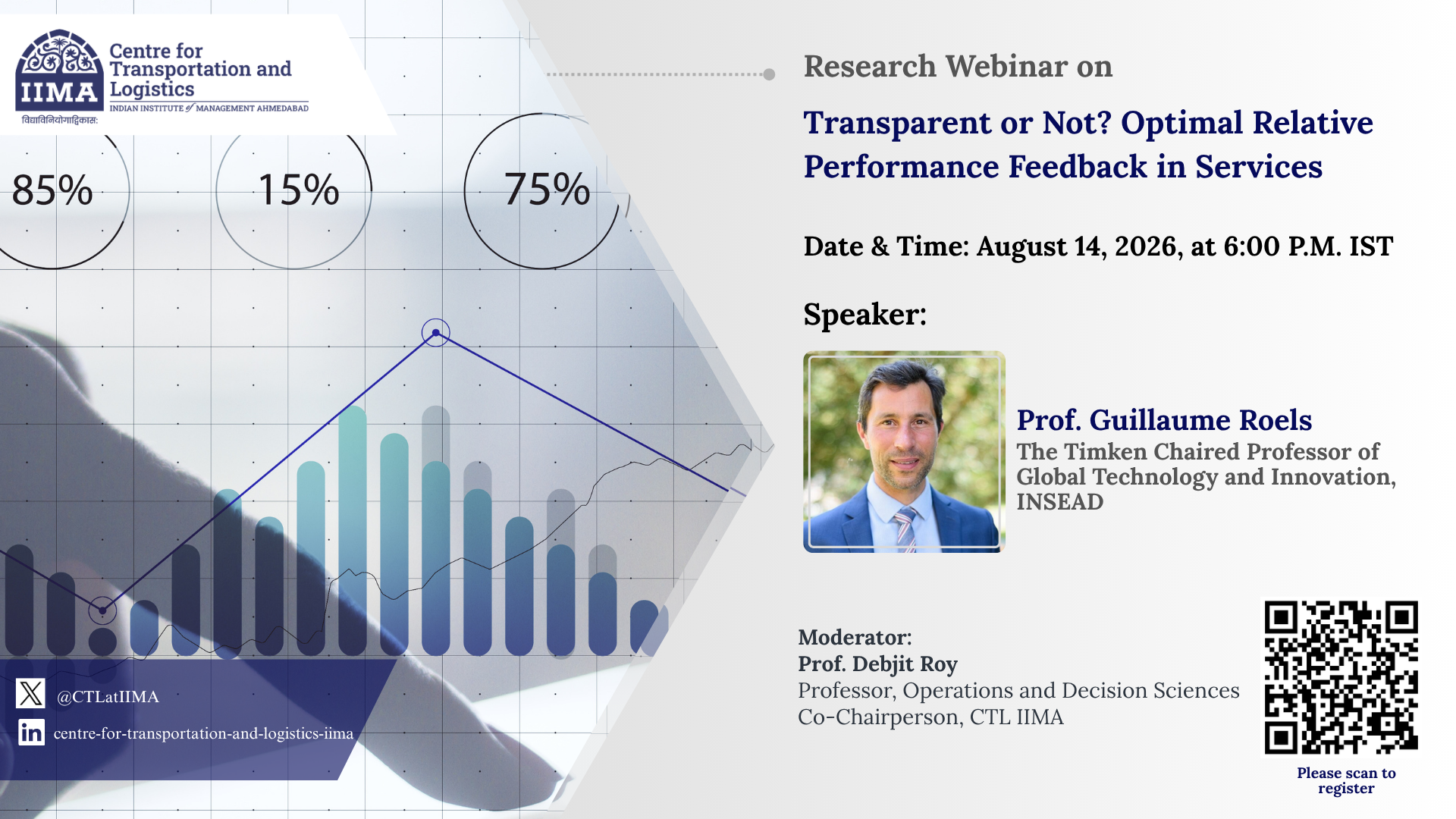
Bio of the Speaker:
Prof. Guillaume Roels, is the Timken Chaired Professor of Global Technology and Innovation at INSEAD. His research lies on the interface of operational excellence, people-centric operations, and the management of services. Recent work has focused on collaborative dynamics in organizations, the design of service experiences, and customer ownership in service systems. Prior to joining INSEAD, Guillaume was an Associate Professor at the UCLA Anderson School of Management. He received an MS degree in Management Engineering and a DEA in Management from the Catholic University of Louvain, Belgium, and a PhD in Operations Research from MIT.
He is teaching courses on operations excellence, supply chain management, service operations, and project management in the full-time MBA, Executive MBA, and various executive education programmes. He is currently the director of the Long Form Online COO Programme. At INSEAD, his POM core was nominated Best Core Course by the GEMBA 22 and 23 students and his elective on Competitive Supply Chains was nominated Best Elective on Fontainebleau Campus by the 18D, 19D and 23J MBA students. He received the Dean’s Commendation for Teaching Excellence in 2018-19, 2020-21, 2021-22, and 2022-23.
He is currently serving as the Editor-in-Chief of Service Science, an INFORMS journal, and was a Department Editor at M&SOM. He also served as the President of the M&SOM Technology, Innovation, and Entrepreneurship (TIE) Specific Interest Group (SIG) and the President of the M&SOM Service Management (SIG). Recent research awards include a finalist position on the 2023 POMS College of Service Operations Management Best Student Paper Competition, a finalist position in the 2023 INFORMS Social Media Analytics Best Student Paper Competition, and a second place in the 2023 INFORMS Service Science Cluster Best Paper Competition.
Abstract:
In many gamified services, users receive relative performance feedback (RPF) upon service completion, either individually (i.e., their rank) or collectively (i.e., the whole score distribution). RPF can vary in degrees of transparency, disclosing percentiles either exactly or in ranges (e.g., top 5-10%), thereby shaping users' expectations about their relative status (driven by ahead-seeking or behind-averse behavior), potentially evaluated with respect to a common percentile benchmark (PB) (e.g., prize for the top 10%). How transparently should service providers convey their RPF to maximize user utility? Using a Bayesian persuasion framework, we determine the provider's optimal information disclosure policy depending on the RPF design, i.e., whether it is individual or collective and whether a PB has been set. Under individual RPF, without a PB, any information policy is optimal; with a PB, users who rank above or just below the PB should only be told that they lie in that range, whereas the others should be told their exact rank. Under collective RPF, without a PB, the provider should be fully transparent (resp., opaque) when users are ahead-seeking (resp., behind-averse); with a PB, the provider should be opaque around the PB. To compare the four RPF designs, we characterize when setting a PB or adopting a collective RPF leads to higher aggregate utility. Our paper offers providers of gamified services guidelines for engineering their RPF to enhance user utility.
[Joint work with Lin Chen, Hong Kong University]