

15/05/2026


Abstract:
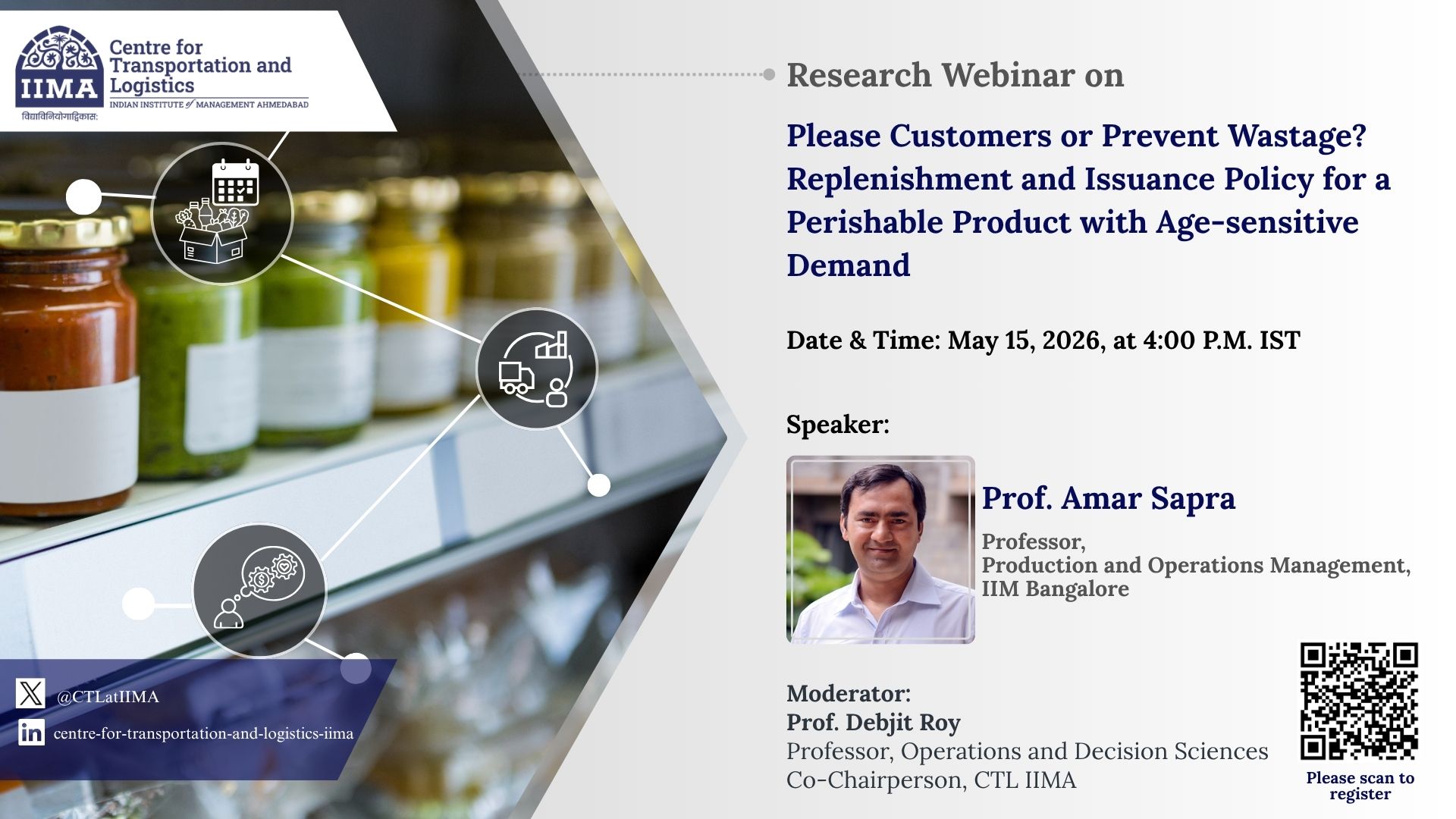
An online retailer selling a perishable product can issue inventories of different remaining lifetimes in its preferred sequence. This creates a trade-off between customer satisfaction and outdating costs since customers want freshness, whereas the retailer desires units be sold within their lifetime. We study this trade-off by considering joint replenishment and issuance policy for a perishable product with a general lifetime. We develop a periodic review model over a finite horizon and model customers' sensitivity to the received unit's remaining lifetime using a goodwill cost, which increases as the remaining lifetime decreases. Although customer satisfaction is likely to be maximized by the last-in, first-out (LIFO) issuance policy and the outdating cost is likely to be minimized by the first-in, first-out (FIFO) issuance policy, neither
policy may be optimal. In particular, when the product lifetime is two periods, it is optimal to first issue new inventory until a threshold and then issue the remaining inventory in the FIFO order. Although the value function is always concave, the optimal issuance policy can become complex for longer product lifetimes. Consequently, we focus on bucket policies in which inventory of each remaining lifetime is issued in a single installment. Our experiments showcase that the best bucket policy's profit is within 0.1% of the optimal profit on average. Motivated by this result, we develop an easy-to-compute heuristic to determine a bucket policy and order quantity and computationally show that its performance is within 1.3% of the optimal profit on average. The heuristic also outperforms many replenishment and issuance policies proposed in the literature. Furthermore, the heuristic is asymptotically optimal with respect to the unit retail price.
About the Speaker:
Prof. Amar Sapra is Professor in the Production and Operations Management area at IIM Bangalore. He completed PhD at Cornell University and BE at IIT Roorkee. Prior to joining IIM Bangalore, he taught at the University of Florida and Cornell University in the United States. Outside of IIMB, he was an independent director on the board of Future Supply Chain Solutions Ltd from 2017-23.
His research interests include Supply Chain Management, Pricing, and Inventory Management. His research has been published in top-tier journals such as Operations Research, Manufacturing and Service Operations Management, Productions and Operations Management, and Information Systems Research. One of the chapters from his PhD dissertation received the prestigious Best PhD Student Paper Award in Operations Management in 2003, given annually by the Manufacturing and Service Operations Management Society. He serves on the editorial review board of the journal, Production and Operations Management. He has also co-authored a book titled, Principles of Inventory Management: When You Are Down to Four, Order More (published by Springer in 2010). He received an Honorable Mention for Best Published Paper in Scheduling and Logistics Track in IIE Transactions (Journal) during 2013 to 2014 for ‘A Continuous Time Analog to the Martingale Model of Forecast Evolution’. He regularly contributes to popular media on articles related to operations and supply chain management.
His teaching experience, spanning nearly two decades, includes teaching high-rated courses on Supply Chain Management, Inventory Control, Operations Management, Spreadsheet Analytics, Simulation, and Optimization.