

30/07/2026


Abstract:
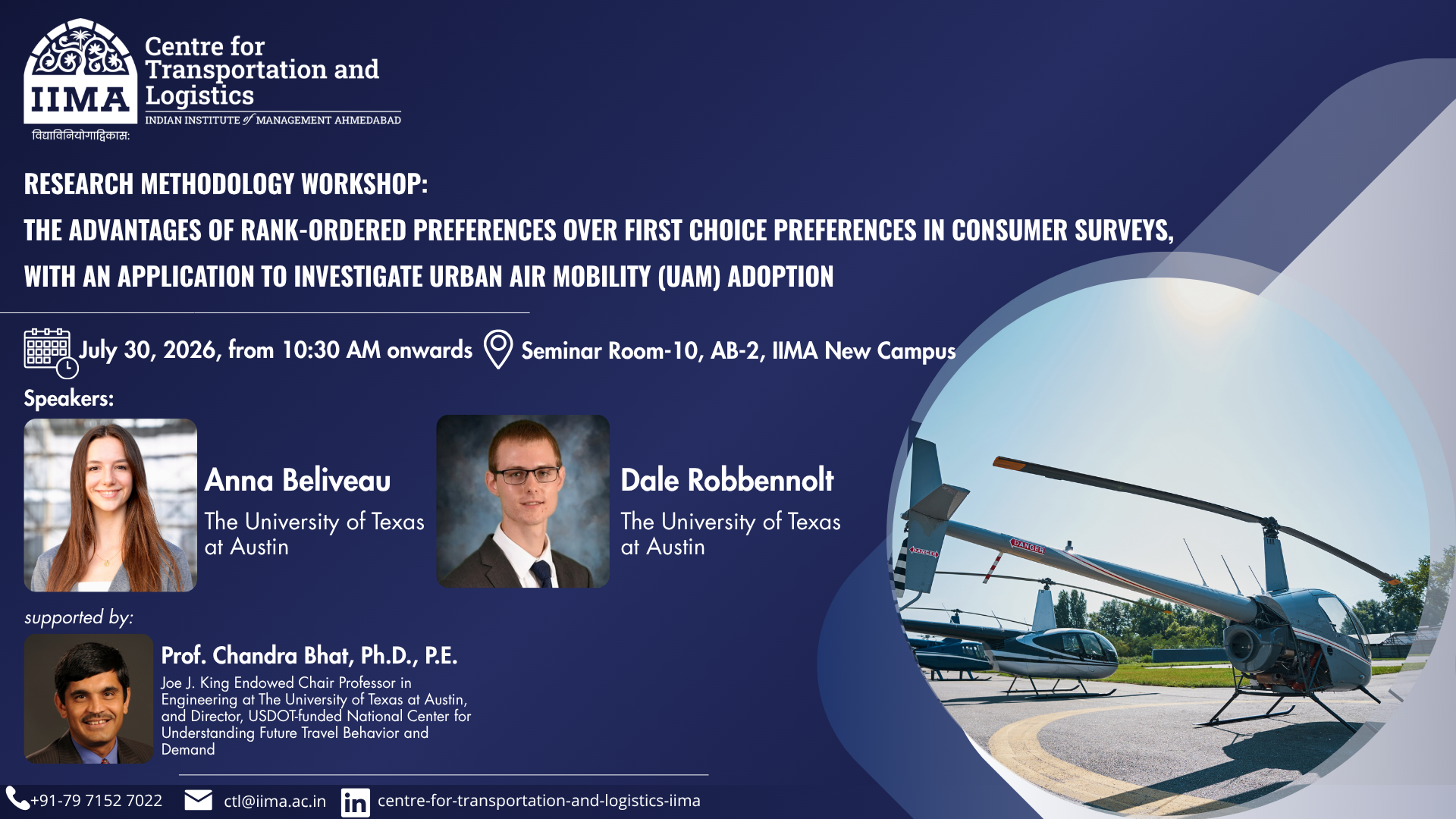
Consumer preference surveys typically ask respondents to identify only their most preferred alternative, even though substantially more information can be obtained by eliciting a complete ranking of alternatives. The continued reliance on first-choice data stems largely from the belief that ranking tasks impose excessive cognitive burden and therefore yield less reliable responses. In this presentation, we show that the commonly observed attenuation of model coefficients with increasing rank depth is more appropriately attributed to model misspecification than to cognitive burden. We then employ a rank-ordered stated preference data collection approach and a corresponding rank-ordered choice modeling framework to examine preferences for urban air mobility (UAM) services. Specifically, our analysis shows how contextual factors (service and trip attributes) together with individual characteristics (including attitudes and lifestyle preferences) shape future UAM service adoption preferences. The results show that UAM preferences are driven primarily by service convenience and travel experience, with UAM modes proving particularly attractive relative to existing ground-based modes for long-distance inter-city travel and time-sensitive medical transport. Adoption preferences also vary systematically with technology attitudes, travel-time preferences, and user characteristics, offering important insights for UAM service design and vertiport planning.
About the Speakers:
Anna Beliveau, from the University of Texas at Austin (UT Austin), has research interests spanning the areas of travel behavior modeling, discrete choice models, pedestrian safety, and future implications of emerging mobility technologies. Currently, her research focus is on predictive modeling of adoption intentions of urban air-mobility package delivery and human mobility services.
Dale Robbennolt, from the University of Texas at Austin (UT Austin), has research interests spanning travel behavior and demand modeling, econometric modeling methods, the adoption and use of emerging transportation technologies, transportation equity, and accessibility. His recent research focuses on work arrangement preferences and implications for commuting patterns.
Supported by:
Prof. Chandra Bhat - He is the Joe J. King Endowed Chair Professor in Engineering at The University of Texas at Austin, where he teaches transportation systems analysis and transportation planning. He is internationally recognized for pioneering the development and application of statistical and econometric methods to analyze human choice behavior in transportation, urban systems, and public policy. He has received numerous honors for his research and professional contributions, including the 2024 W.N. Carey, Jr. Distinguished Service Award from the Transportation Research Board (TRB), the 2022 Theodore M. Matson Memorial Award from the Institute of Transportation Engineers (ITE), the 2017 Council of University Transportation Centers (CUTC) Lifetime Achievement Award, and the 2013 Alexander von Humboldt Research Award. Dr. Bhat has consistently been ranked among the world's top three researchers in transportation and logistics. He is the immediate past Editor-in-Chief of Transportation Research Part B: Methodological and currently serves as Director of the USDOT-funded National Center for Understanding Future Travel Behavior and Demand.